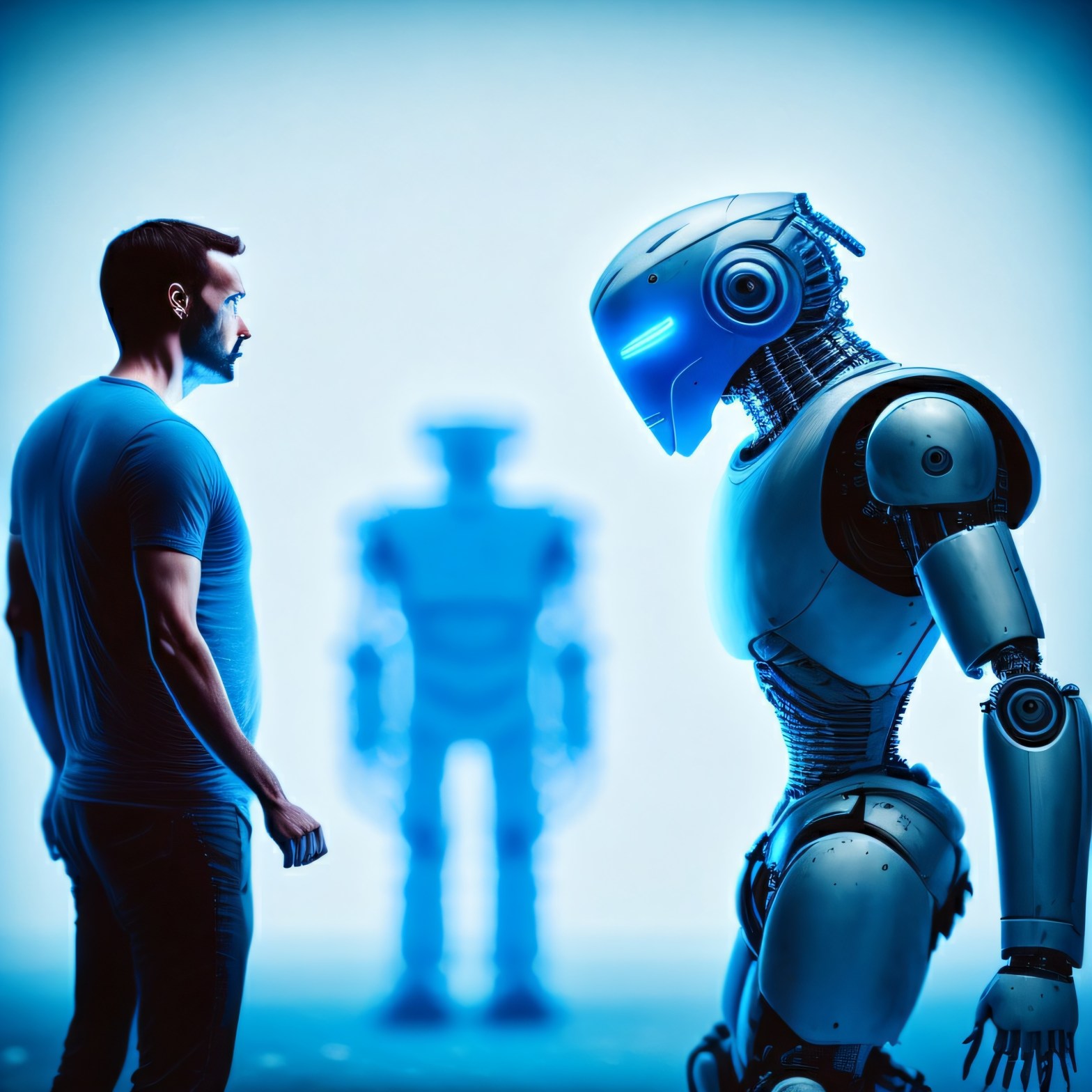
Have you ever wondered what makes us human? What sets us apart from the machines that we create and use? In this blog post, we will explore some of the unique aspects of human intelligence that give us an edge over artificial intelligence (AI), even as AI becomes more advanced and ubiquitous. We will look at some of the limitations and challenges of AI, and how humans can leverage their strengths to complement and collaborate with AI. Here are some of the topics we will cover:
- The difference between human and artificial intelligence
- The importance of common sense, creativity, and empathy for human intelligence
- The potential benefits and risks of AI for society and work
- The ways humans can enhance their intelligence and skills in the age of AI

The difference between human and artificial intelligence
Artificial intelligence is a broad term that refers to the ability of machines to perform tasks that normally require human intelligence, such as reasoning, learning, decision making, and problem solving. AI can be classified into two types: narrow AI and general AI. Narrow AI is focused on specific domains or tasks, such as playing chess, recognizing faces, or translating languages. General AI is the hypothetical ability of machines to exhibit intelligence across any domain or task, similar to or beyond human intelligence.
While narrow AI has made remarkable progress in recent years, thanks to advances in computing power, data availability, and machine learning algorithms, general AI remains elusive and controversial. Some experts believe that general AI is possible and inevitable, while others doubt that machines can ever achieve the same level of intelligence as humans.
One of the main reasons why general AI is hard to achieve is that human intelligence is not just a matter of computation or logic. Human intelligence is also influenced by factors such as emotions, intuition, creativity, social skills, and common sense. These factors enable humans to understand complex situations, adapt to changing environments, generate novel ideas, and collaborate with others. These factors are also difficult to replicate or simulate by machines.
The importance of common sense, creativity, and empathy for human intelligence
Common sense is the ability to use practical knowledge and experience to make sensible judgments and decisions in everyday situations. Common sense helps humans to avoid absurd or dangerous actions, infer implicit information, fill in missing details, and cope with uncertainty. Common sense is often taken for granted by humans, but it is challenging for machines to acquire and apply.
One of the reasons why common sense is hard for machines is that it requires a large amount of background knowledge about the world and how it works. This knowledge is often implicit, contextual, and subjective, which makes it difficult to formalize or encode in a way that machines can understand. Another reason is that common sense involves reasoning about causality, morality, intentions, goals, and beliefs, which are not easily captured by mathematical models or algorithms.

Creativity is the ability to produce original and valuable ideas or products that solve problems or satisfy needs. Creativity helps humans to innovate, discover, invent, and express themselves in various domains such as science, art, literature, music, and business. Creativity is often associated with inspiration, imagination, intuition, and insight. Creativity is also influenced by factors such as motivation, personality, culture, and environment.
Creativity poses a challenge for machines due to a couple of factors. Firstly, it demands the ability to think outside the box and delve into various possibilities, which machines struggle with. They tend to adhere to predetermined rules or procedures, restricting their exploration and constraining their outputs. Furthermore, creativity entails the capacity to assess and acknowledge the quality and significance of ideas or products. Machines lack the subjective benchmarks or criteria employed by humans to evaluate creativity.

The power of empathy lies in its capacity to comprehend and embrace the emotions, thoughts, and viewpoints of those around us. By exercising empathy, we enable ourselves to establish effective lines of communication, establish trust and rapport, and foster cooperation and collaboration with others. Moreover, empathy enables us to genuinely care about the welfare of others and to act in an ethical and compassionate manner. This ability is often influenced by our emotional states, individual traits such as agreeableness, and the social norms and values we adhere to.
Empathy proves to be a challenge for machines due to several factors. Firstly, emotional recognition and expression play a crucial role, which machines struggle to grasp. The intricate cues like facial expressions, body language, tone of voice, and contextual understanding that humans effortlessly utilize to communicate their emotions are not easily detectable or interpretable by machines. Furthermore, machines lack the innate capacity to generate and exhibit appropriate emotions that align with specific situations and intended audiences.
Another hurdle lies in empathy’s reliance on perspective-taking and theory of mind. Machines encounter difficulties in deducing and simulating the mental states of others, including beliefs, desires, intentions, and expectations. Unlike humans who draw reference from personal experience and history to establish connections with others, machines lack this essential human aspect, making empathy even more elusive.
The potential benefits and risks of AI for society and work
The potential of AI is immense in terms of benefits it offers to society and the workplace. It has the capability to boost productivity, efficiency, quality, innovation, and convenience. Moreover, AI can play a pivotal role in finding solutions to critical challenges that humanity confronts, including climate change, poverty, healthcare, education, and security.
However, AI also poses some risks and challenges that needs to be carefully managed and mitigated.
Some of these risks and challenges include:
- Ethical and moral issues, such as bias, discrimination, privacy, accountability, transparency, and human dignity
- Social and economic issues, such as unemployment, inequality, polarization, and social cohesion
- Legal and regulatory issues, such as liability, responsibility, ownership, and governance
- Technical and security issues, such as reliability, robustness, safety, and malicious use
How humans can enhance their intelligence and develop their skills in the age of AI
In order to reap the benefits and avoid the risks of AI, humans need to enhance their intelligence and skills in the age of AI. Some of the ways humans can do this include:
- Learning to use AI tools and systems effectively and responsibly, by acquiring digital literacy, data literacy, and AI literacy
- Learning to collaborate with AI tools and systems efficiently and harmoniously, by developing human-AI interaction skills, such as communication, coordination, and feedback
- Learning to complement AI tools and systems creatively and empathetically, by leveraging human strengths, such as common sense, creativity, and empathy
- Learning to adapt to AI tools and systems continuously and proactively, by embracing lifelong learning, reskilling, and upskilling
Conclusion
Artificial intelligence (AI) possesses immense potential to revolutionize society and the workplace, however, it also presents certain limitations and obstacles that necessitate attention. Humans possess a certain advantage over AI in specific intellectual domains, such as practical wisdom, imaginative thinking, and emotional understanding, which are crucial for resolving intricate issues and generating value in our world. In order to flourish in the era of AI, individuals can effectively augment their intellect and expertise by acquiring the proficiency to utilize, cooperate with, complement, and adapt to AI tools and systems. This proactive approach ensures that humans continue to remain pertinent and competitive as AI becomes increasingly prevalent.
Are you prepared to seize the prospects and face the obstacles presented by AI? Are you interested in gaining a deeper understanding of how to improve your intellect and abilities in the era of AI? If that’s the case, we encourage you to subscribe to our blog and share your valuable insights in the comments section.

 Chibzy Tech Blog